
I moved to Kansas with a list of priorities. Build the business, show up for the kids, pay attention to the house projects, keep the damn lawn alive. For a while those priorities were a perfect scaffolding. They kept me moving forward, made life simple enough to manage. Head down, plan, execute, repeat. Father mode. Builder mode. Productive, accountable, useful.
Then last week I flew to a little town in Mexico I used to call home for five years. I went alone, because that is how I travel these days: small bag, no agenda, room for whatever arrives. Five days later I came home with my love tank overflowing and a single quiet realization that has been rolling around in my head since: I hadn’t known how empty I was without friends.
That sentence sits heavy, because there is a cultural myth I fell for, like a lot of men do: I can be enough on my own. I’ve got responsibilities. I have family. I have work. I can shoulder the isolation because that’s what men do. We show up, we solve, we fix. We do not burden others. We do not complain. We certainly do not need a posse of people who just get us.
And yet, in that small Mexican town, with friends I hadn’t seen in years, I learned how wrong I’d been.
What five days taught me
The place is not important by name. Call it the town that smells like coffee and wood smoke at dawn, where the ocean breathes cool wind into a plaza, and the street dogs know you by your sandals. The thing people there have, without fuss, is time. Time to laugh until your ribs hurt. Time to sit and not think about who’s emailing you. Time to hear someone tell a stupid story and listen like it matters.
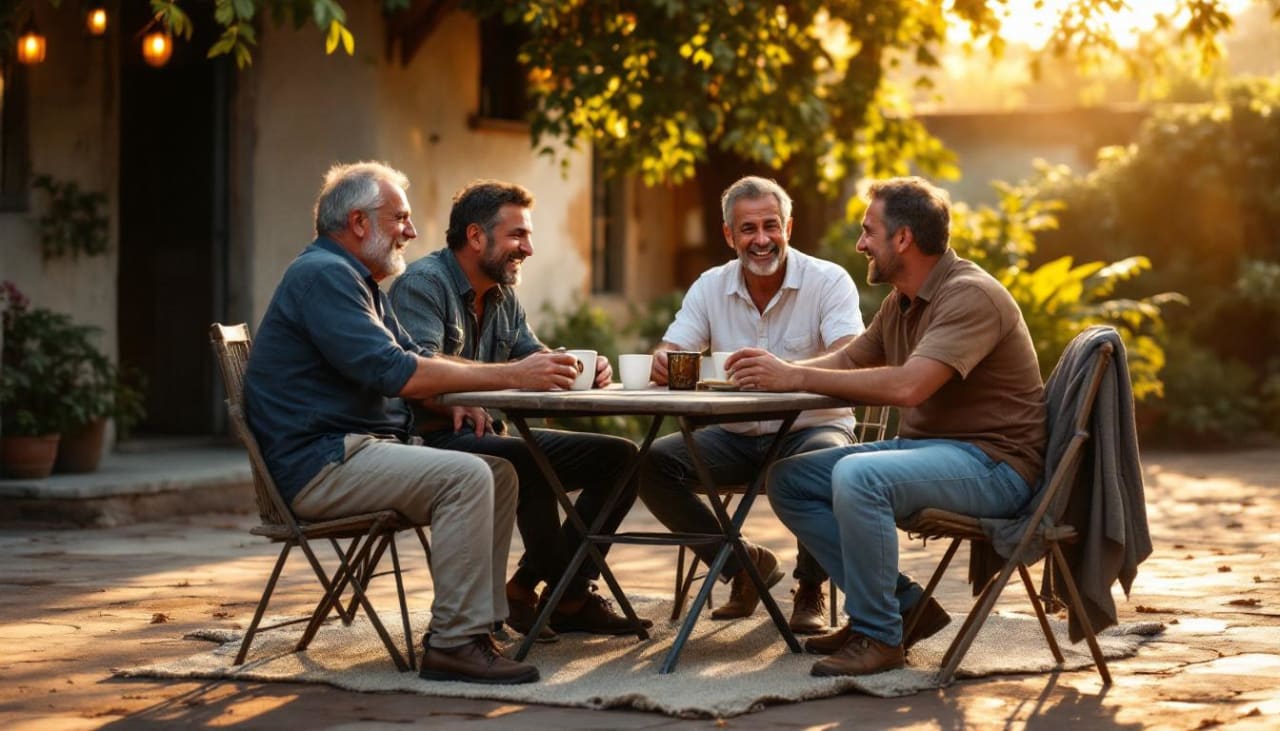
I watched a simple scene that turned into a revelation. Four of us, two old friends and two people I’d just met, sat on a low wall at sunset. Someone brought tamales, someone else a bottle of something strong and sweet. The conversation meandered like a river: work regrets, small triumphs, childhood embarrassments, a loud confession about being terrified of his teenage son leaving home. There were moments of real silence, where no one tried to fill the air. There were jokes that landed so perfectly we all laughed like fools, and a serious story told in two sentences that had us all wiped clean by the end.
After that night I walked back to my room under a sky crowded with stars and felt a simple truth settle–being heard is medicine. Hearing and being heard turns experiences into reality. It makes suffering less opaque, makes joy more luminous. Shared life isn’t a luxury. It is, quietly, essential.
Why men lose friends, and why it matters
There are practical reasons friendships thin out as life fills up. You move cities for work. You marry. You have kids. Your calendar fills with obligations that have real consequences if missed. Friendships become something you will get to when everything else is done.
But there are deeper reasons too. Society hands men a script: be self-sufficient, contain your feelings, don’t lean publicly on others. Over time, following that script creates a kind of muscle memory where reaching out feels risky. There’s shame attached to neediness. There’s a fear of being seen as weak. So you shrink the list of people who know the real you, and you sharpen a version of yourself that is useful, competent, and quiet about internal uncertainty.
And then some invisible things start to happen. Problems feel larger when carried alone. Joy is muted because there’s no one to mirror it back. The milestones are smaller when shared only with a partner or kids. Loneliness, even when surrounded by people, gnaws at the edges. It alters your stress response. It reduces resilience. It makes decision-making more brittle. The truth is plain, backed by data and experience: men with consistent, deep friendships live longer, recover from stress more easily, and report higher life satisfaction.
Still, those facts are not enough to change behavior. Practical advice works better when combined with understanding. Friendships matter because they make your internal world real. They are a mirror, a sounding board, a place to fail and be forgiven. They are where you practice vulnerability, and vulnerability is the training ground of courage.
Sharing makes things real
I keep returning to that image of the tree falling in the forest. Philosophers used it to ask if something exists if it is unobserved. The version that matters to me now is human. If you feel something, and nobody hears it, does it make a difference? That question is not metaphysical. It is practical. Saying something out loud, or sharing a moment, localizes it. It ties your inner experience to a social witness, and the world responds. Emotion needs context to be processed. Joy needs mirroring to become celebration. Grief needs witness to begin its healing arc.
There is also a biological layer. When we connect, hormones shift. We release oxytocin and lower cortisol. Our hearts slow. We physically feel safer. Being with others is not just nice, it is restorative. That is why a single long, honest conversation after a rough week can change the trajectory of the next two months. It recalibrates expectation, resets stress markers, and recharges a worn-out part of your psyche.
If you have been delaying a phone call, a coffee, a meetup, know this: the first step is the one that matters most. The second step usually comes easier.
How to start again, practically
I am not going to lecture you about vulnerability like it is a virtue you should add to your grocery list. Instead, here is a practical playbook you can use tomorrow. Small, specific actions that lower the bar, reduce shame, and increase the chance that you will re-enter the life of friends you once loved or begin to build new ones.
-
Make a short list
Write down three names. Someone you miss. Someone you always meant to see. Someone you enjoy but rarely call. Keep it to three. Small lists reduce the avoidance behavior. -
Use scripts that work
The hardest part is getting the words out. Use simple, low-pressure messages.- “Hey, been thinking about you. Coffee this week?”
- “Long time. Any chance you’re around for a walk Saturday?”
- “I’m back in town for a couple days. Want to grab a beer tonight?”
-
Schedule first, feel later
Make the plan, then show up. A lot of fear lives between now and the first step of showing up. Commit on calendar. Block the time. Treat it like a meeting you cannot miss. -
Bring one real thing to the conversation
Don’t plan to change your life in one chat. Bring one piece of genuine substance: a funny story, a fear you had last week, something you are proud of. Keep it small and honest. -
Listen like it matters
Practice a short listening ritual. Three minutes of uninterrupted speaking, then reflect back what you heard in one sentence. Ask one thoughtful question. Most of us have never been taught to listen; leaning into it will be noticed and remembered. -
Build rhythm, not intensity
Friendships grow with repetition. A weekly run, a monthly dinner, a twice-monthly phone call. Consistency beats intensity. Start small and weave the habit into your life. -
Invite through doing
Shared activities form bonds faster than confessional nights alone. Join a group fitness class, volunteer, do a weekend project club. When people work together, they reveal character, and character creates trust. -
Expect awkward, plan for it
Awkward is part of the process. Say it aloud. “This is weird, we haven’t done this in years.” Humor dismantles a lot of distance. -
Hold boundaries where needed
You can be open and still protect your family, career, and time. Say yes to connection and no when something feels consuming. Friendship is not neglecting responsibilities. It is adding support to them. -
Be the inviter
If everyone waits for the other side to call, nothing happens. Invite. Rejection will sting once. Regret lasts forever.
Vulnerability redefined: courage over weakness
For men, vulnerability gets framed as a weakness. Reframe it as courage. The first time I admitted to a group of friends that I felt adrift after a move, my hands shook. I felt ridiculous, exposed. But what rolled out of that admission were stories