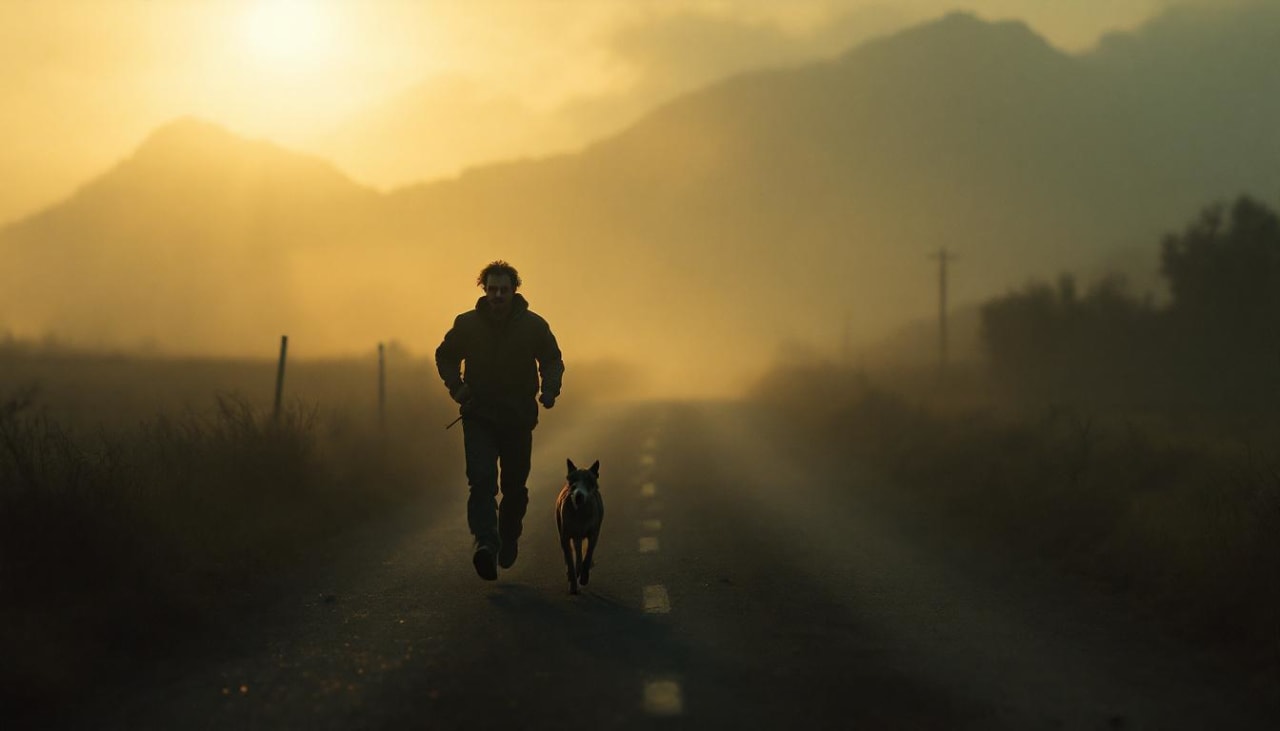

He woke up alone. The house felt too big. The coffee tasted like an accusation. His dad said two words and left them like a bruise: “I thought...” It was the kind of moment that makes you either implode or begin to crawl toward something you do not yet understand.
Years later he wrote on X:
“I woke up that first day without her lost. Alone. I had no idea what to do. First couple days I wallowed. My dad chastised me. ‘I thought you were stronger than this.’ … That next day I woke up early and took my dog for a walk. Watched the sunrise on a pier near my house.… Then I started biking. Then running. I died. I hated running. I liked how I felt after though. I did it again.”Now he runs ultras. He weighs less. He laughs at how addicted he is. He says, plain and true:
“If you feel lost and can’t find the answers, just start moving. Get outside.”
This is not fluff. This is the Hero’s Journey in a hoodie. It is falling into an abyss and finding out the abyss has a path. It is a man answering a call not from a horn or a guru, but from his own two feet. Movement became a ritual. Ritual became discipline. Discipline rewired his nervous system. Rewiring revealed a life he had not allowed himself to try on.
If you are reading this because something cracked in your life and you do not know how to put the pieces back together, you have already been invited into the same story. The question is what you will do with the invitation.
Movement as the first yes
There is a particular clarity in physical motion. When your body moves, your mind follows. That is not metaphor. It is a hard biological fact. Walking toward a sunrise is an action that biases your brain away from rumination and toward sensory input. Sunlight nudges your circadian clock. The rhythm of your feet steadies the nervous system. Air in your lungs means a vagal tone boost. You go from trapped inside story to a body that knows forward.
When the man on the pier chose to walk, he did three things at once. He created a cue. He created a small, repeatable action. He created a reward: the sunrise, a changed chemistry, a feeling of not having collapsed into the couch and conceded failure. The cycle was simple: cue, routine, reward. Small, honest, repeatable. That is where transformation begins.
Movement interrupts the story. When you put one foot in front of another, you make rumination into rhythm. You trade the looping neural track of “I am lost” for a new track: “I show up.” That is all it needs to begin rewiring.
The physiology of starting small
You do not earn your new life through heroics. You earn it through tiny, repeated acts. The brain and body change through micro-doses of stress followed by recovery. That is progressive overload in exercise and in the nervous system. A five-minute walk every morning is a stressor that the body tolerates well and then adapts to. You create more mitochondria. You raise BDNF, the brain’s fertilizer for new neurons. You soothe the amygdala. You strengthen the prefrontal cortex that makes choices instead of reacting.
Here are the practical pieces the man did and that you can steal:
- Start with a non-negotiable cue. For him it was the dog and sunrise. For you it could be brushing your teeth, stepping outside, or switching on an alarm named “move.” Make the cue specific: Tuesday, 6:15 a.m., dog leash in hand.
- Make the routine micro. Five minutes counts. Ten minutes counts. The point is to replace inertia with action. Action beats intention every time.
- Track the reward. Not “I ran a mile.” The reward is how you feel after. Write it down. It is astonishing how often we overlook the most powerful incentive: pleasure after doing something good for ourselves.
- Scale slowly. Walk until walking is habitual. Then add a little resistance. Walk faster. Add a light jog. Swim. Bike. The stepping stones are boring, and that is precisely why they work.
This is habit science and it is also ancient. The Stoics tell us to practice the thing we fear in small parts. The Indian gyms of old required dancers to hold a pose until it became effortless. The message is the same: mastery happens in repetition, not revelation.
Discipline through movement–how the body makes the heart brave
Discipline gets a bad rap because people equate it with self-punishment. Real discipline feels different. It is sovereignty over the most chaotic part of your house: your body. The man on the pier did not decide to become an ultrarunner overnight. He decided to show up and keep showing up. That consistency carved pathways in his nervous system that made further showing up easier.
Running, in particular, teaches a few brutal lessons that map straight to life:
- You get comfortable with discomfort. Running longer than you have run before is a controlled exposure to suffering. If you can learn to tolerate that narrow band of discomfort, you expand your capacity to tolerate the larger, messier discomforts of life.
- You learn pacing and patience. Marathons and ultras punish pride and reward pacing. You learn the art of investing energy across time, a skill men under midlife stress sorely lack.
- You build confidence that is earned. No pep talk substitutes for logged miles. Confidence from habit is different from the brittle confidence of performance. It lasts.
- You build community. The people you meet while training become allies. They hold you accountable. They know your bad days and your hallucination stories. Brotherhood forms through shared adversity.
There is also a chemistry lesson. Movement increases dopamine in manageable bursts. It lowers cortisol when done consistently. It increases serotonin and endorphins. Over weeks and months, it lifts the fog. Depression’s grip loosens. You get better sleep. You think clearer. Your frontal lobes get more oxygen and make better decisions. The body is not a frivolous element of transformation. It is the platform on which all deeper work runs.
Shadow work for runners: what your pain teaches you
The man’s father said, “I thought you were stronger.” That cut. That critique is an archetype: the disappointed father, the internalized judgment that shrinks you when you need to grow. Movement does not erase that voice. Instead, it allows you to approach it and examine it without being consumed by it.
Shadow work is not glamorous. It is naming the parts you avoid and then integrating them so they stop sabotaging you. In practice this looks like two parallel tracks:
- The external track of movement and habit. This is the training log, the mileage, the Tuesday group run.
- The internal track of reflection and naming. This is the five-minute journal after your run where you write the phrase that stays in your throat. It is the sentence you do not say aloud. It is the memory you feel whenever someone tells you to “be stronger.”
Put the two together. Run until you are honest enough to notice who you are while you run. Notice when you run to outrun shame. Notice when you run to fill a silence. Notice when your body is tired and your pride is louder than your lungs.
That noticing is the beginning of integration. You are less likely to be hijacked by your shadow when you have a simple ritual that brings it into daylit reality. Movement creates those opportunities. Sometimes the dark shows up as rage at a hill. Sometimes it shows up as the ache of loneliness that no PR can fix. Whatever it is, naming it without moral drama is the gateway to integrating it.
Redefining masculine strength
The cultural picture of masculine strength is brittle. It imagines the man who never cracks. Who is always “strong” and never needs help. That picture harms more men than it helps. The real north of masculinity sits at the intersection of two things that appear contradictory at first glance: fierce accountability and tender vulnerability.
Running teaches both. The man who trains for ultras holds himself to a brutal standard. He does recovery. He respects sleep. He shows up for group runs. He eats right. He is disciplined. At the same time he tells his friends when he is lonely. He shows up with a confession. He laughs at his hallucinations. He asks for help with his pacing. He allows intimacy with teammates.
This is the redefinition of strength. Strength is not the absence of feeling. Strength is the capacity to feel without being undone. It is the ability to carry someone else because you have first learned to carry yourself. It is saying “I am struggling” and then going for the run anyway. It is pairing relentless action with honest conversation.
Brotherhood forms in unexpected ways. A Tuesday morning loop, a Thursday tempo run, a Saturday long run. These are not social media moments. They are bloodlines formed by shared endurance. In them, men